A European Town Twinning Event for Sustainable Urban Transformation was held in Alexandreia, Greece, from 5 to 7 May 2026.
From 5 to 7 May 2026, the Institute for Promotion and Certification of Agri-Food Products, in cooperation with the Municipality of Alexandreia, successfully organised the European Town Twinning event of the project “BioBOND: Bonding Cities for a Bio-Driven and Sustainable Urban Future”, under the framework of the CERV Programme.
The event focused on the role of sustainable urban transformation in shaping the future of European communities, with particular emphasis on the principles of the New European Bauhaus initiative.
Bringing together local authorities, civil society organisations, experts and citizens, the event created a platform for dialogue on how public spaces can become greener, more inclusive, aesthetically valuable and resilient, while strengthening civic participation and community well-being.
Through knowledge exchange and mutual learning, participants explored innovative approaches for designing urban environments that place people, sustainability and social cohesion at the centre of local development.
Partner Consortium
The partner consortium included five participating countries:
- Greece
- Italy
- Poland
- Bulgaria
- Serbia
The participating partners were:
- Institute for Promotion and Certification of Agri-Food Products (Greece)
- Comune di Calimera (Italy)
- Gmina Andrespol (Poland)
- Petrich Municipality (Bulgaria)
- Regionalna Razvojna Agencija Backa DOO Novi Sad (Serbia)
Through this cooperation, the project brought together municipalities, local authorities, civil society organisations, youth representatives and citizens to explore how European towns can respond collectively to common environmental and social challenges.
Day 1
Participants arrived according to their group schedules and were welcomed in an informal setting that encouraged first exchanges among the delegations.
The welcome dinner created a friendly and collaborative atmosphere, allowing participants to meet one another, share initial impressions and establish connections that set the tone for the discussions and exchanges during the main conference programme.
Day 2
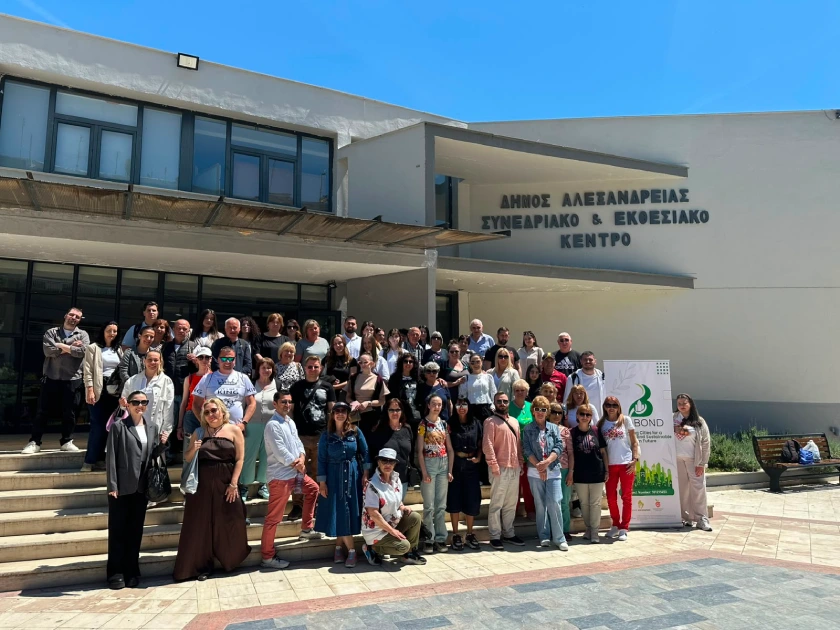
The second day marked the core of the BioBOND event, with the main conference activities taking place at the Cultural Center of Alexandreia.
The programme opened with registrations and welcome coffee, followed by institutional greetings and an introduction to the Town Twinning project.
The Municipality of Alexandreia welcomed the participants, while representatives from the partner organisations presented their local contexts and highlighted the importance of cooperation between European towns in addressing shared challenges related to sustainability, urban resilience and civic engagement.
Sustainable Urban Transformation
Following the opening session, the agenda moved into a broader discussion on sustainable urban transformation and the role of public spaces in community life.
Mr. Christodoulos Arxontis, Political Scientist, delivered the session “Transforming Public Spaces for Sustainability”, introducing the BioBOND project and its alignment with the CERV Town Twinning call.
His presentation also explored the European Green Deal and the New European Bauhaus initiative, highlighting how European priorities can be translated into practical local action for more sustainable and inclusive public spaces.
European Environmental Policies
The programme continued with expert contributions on European environmental policies and local sustainability strategies.
Mr. Anastasios Veniopoulos, Lawyer and EU Project Manager, presented the session “Exploring EU Policies for Sustainable Urban Transformation”, focusing on the EU Biodiversity Strategy, the Circular Economy Action Plan, and the EU Climate Pact.
Participants examined how EU policy frameworks can support municipalities in developing greener urban strategies, strengthening climate resilience and connecting local initiatives with wider European goals.
Best Practice Exchange
Special attention was given to the exchange of local experiences and transferable good practices.
Mrs Ioanna Kynigopoulou, Political Scientist, presented the session “Best Practices for Eco-friendly Public Spaces and Youth-led Projects”, showcasing case studies from partner towns and examples of youth-led initiatives supporting environmental protection and civic engagement.
The discussion explored how successful practices can be adapted to different local contexts and how public spaces can become greener, more inclusive and more accessible for all citizens.
Behavioural Change and Community Well-being
The conference also addressed the human and behavioural dimension of sustainability.
Mrs Stella Ntouvi, Psychologist and EU Project Manager, delivered the session “Behavioral Change and Community Well-being in Sustainable Cities”.
Her presentation focused on how people interact with public spaces and what motivates environmentally responsible behaviour, emphasising that sustainable urban transformation is not only about policy and infrastructure, but also about everyday habits, community well-being and active citizenship.
Conference Conclusions
The conference programme concluded with closing remarks, bringing together the main findings and outcomes of all sessions.
Participants highlighted the importance of cooperation between municipalities, citizens and civil society organisations, as well as the need to connect European policy frameworks with local experiences and the practical needs of communities.
Throughout the programme, BioBOND created an inclusive environment where European priorities met local realities, strategic planning was linked with active citizen participation, and practical experiences were openly shared.
The event further strengthened dialogue among municipalities, civil society organisations and citizens, encouraging participants to reflect on the future of urban spaces and the role of local communities in driving sustainable change.


Conclusion
The BioBOND event once again demonstrated the value of Town Twinning in connecting European communities and transforming shared challenges into opportunities for cooperation.
Through expert presentations, open dialogue and the exchange of practical experiences, participants deepened their understanding of sustainable urban transformation, civic engagement and European cooperation.
The Municipality of Alexandreia, together with the Institute for Promotion and Certification of Agri-Food Products and the European partners, created an inspiring environment for dialogue, learning and future collaboration.
By embracing the values of the New European Bauhaus—sustainability, inclusion and aesthetics—the event demonstrated how local communities can actively contribute to creating greener, more resilient and people-centred urban environments.
The event concluded with a strong sense of shared commitment, leaving participants with valuable knowledge, renewed motivation and stronger partnerships that will contribute to the development of greener, more resilient, inclusive and sustainable cities across Europe.
Documentation
The complete description of the event and the activities carried out within the BioBOND project is available in the official document: